Complex NumbershardFree
Complex Numbers Concyclic Points with Origin | 2/z1 = 1/z2 + 1/z3
JEE Maths question with a full step-by-step solution.
If are the non-zero complex numbers representing the points such that
then which of the following is true?
A are collinear.
BA circle passes through the points and has centre at the origin .
CA circle passes through the points and passes through the origin.correct
DNone of these.
Step 1: Rearrange the given condition.
Starting from
split the left side as and regroup:
Step 2: Combine each side into a single fraction.
Since , cancel from both denominators
Step 3: Solve for the ratio of differences.
Cross-multiplying gives
and replacing ,
Step 4: Take the argument of both sides.
Step 5: Express the right side relative to the origin.
Since ,
Step 6: Interpret geometrically.
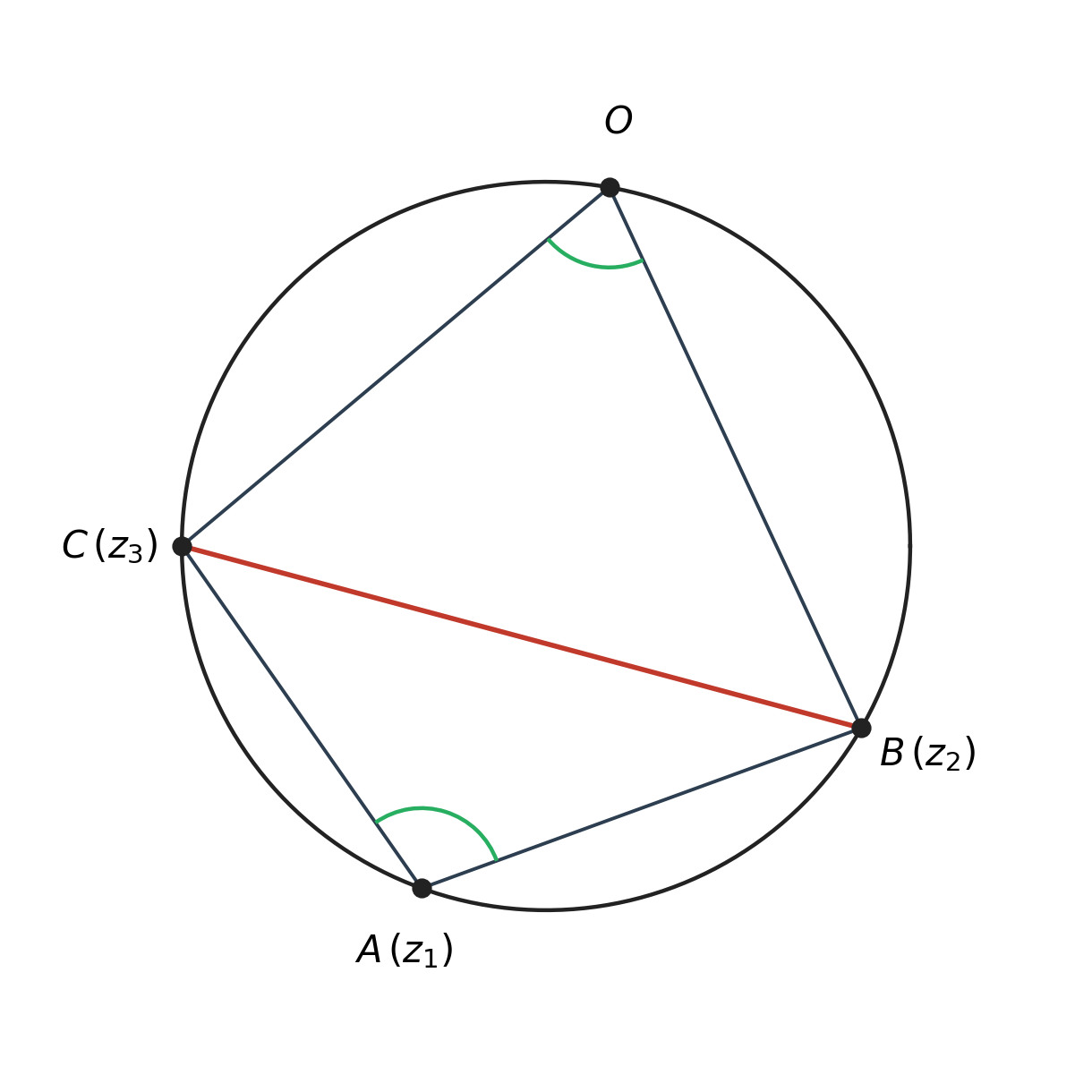
The term is the angle subtended by the segment at the point , and is the angle subtended by at the origin . Their difference equals , which means the inscribed angles that subtends at and at are supplementary. Consequently and lie on opposite arcs of the circle determined by and , so the four points are concyclic.
Therefore a circle passes through the points and also passes through the origin.
(See the figure: the chord subtends supplementary angles at and at , so lie on one circle.)
Correct answer: (3)
Solve more, learn faster
Sign up free to solve more JEE Maths questions and explore doMath — timed drills, mastery sprints, bookmarks, and chapter-wise progress tracking.