Basics & LogarithmsmediumPYQ · JEE Main · 16 Mar 2021 · Shift 1 (Morning)Free
Basics & Logarithms: Number Elements Set Equal (JEE Main 2021)
JEE Maths question with a full step-by-step solution.
The number of elements in the set is equal to
A
Bcorrect
C
D
Step 1: If , divide both sides by :
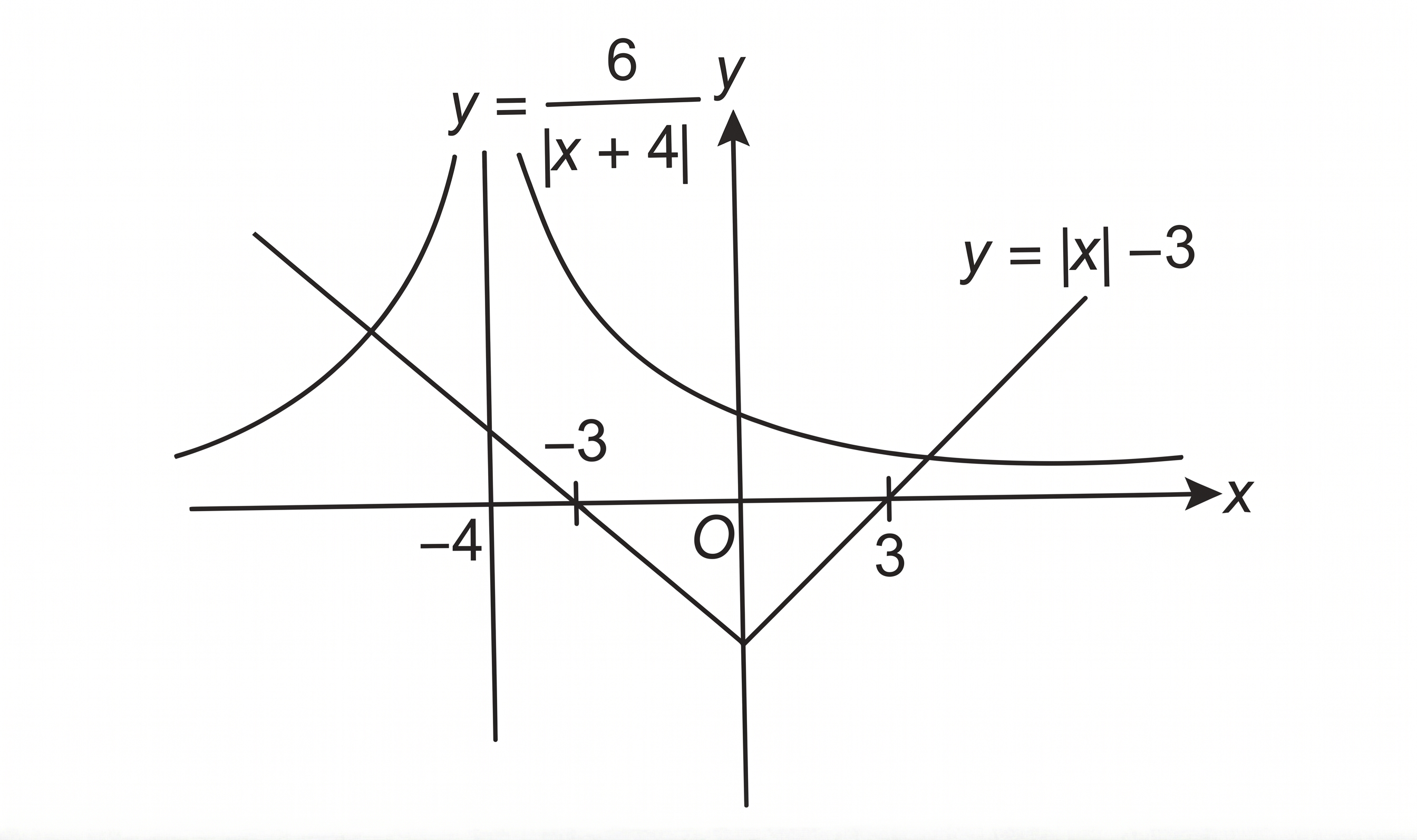
Step 2: From the graph (book approach): plot (V-shape, vertex at ) and (hyperbola-type, always positive, with vertical asymptote at ).
Step 3: The curves can intersect. The equation means .
For : multiply both sides: .
Step 4: From graph analysis, the two curves intersect at points.
Verification algebraically:
Case : .
(accepted). (rejected).
Case : . Discriminant . No solution.
Case : .
Sub-case : . Same as above: . No real solution.
Sub-case : .
(rejected, not ) or (accepted).
Step 5: Solutions: and . So elements.
Answer: (2)
Basics & Logarithms · easy
If , then the value of the expression is
Basics & Logarithms · easy
Number of integral values of satisfying the inequality is:
Basics & Logarithms · easy
Number of natural numbers for which the number is defined is:
Basics & Logarithms · easy
The product of all solutions of the equation , , is
Solve more, learn faster
Sign up free to solve more JEE Maths questions and explore doMath — timed drills, mastery sprints, bookmarks, and chapter-wise progress tracking.