Application of IntegralsmediumFree
Application of Integrals: Let Point Origin Lying Parabola Normal Line Parabola
JEE Maths question with a full step-by-step solution.
Let be a point (not the origin) lying on the parabola . The normal line to the parabola at
will intersect the parabola at another point . The minimum possible value for the area bounded
by the line and the parabola is
A
B
Ccorrect
D
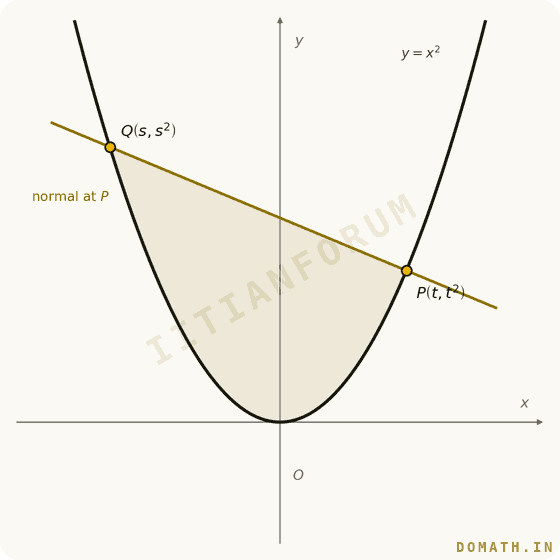 Step 1: Let . is not the origin, so , and the parabola is
symmetric about the -axis, so let . Since , the tangent slope at is
and the normal slope is :
Step 1: Let . is not the origin, so , and the parabola is
symmetric about the -axis, so let . Since , the tangent slope at is
and the normal slope is :
Step 2: Putting ,
is a root, being , so factor it out:
Both and are positive, so , and lies on the other side of the axis.
Step 3: If a line meets at and with , the integrand is
, and its integral over is
:
Step 4:
By AM-GM,
with equality when , i.e. , which is allowed, since is not the
origin.
Step 5: is increasing for , so
and the bound is attained:
Answer: (3)
Application of Integrals · medium
The area of the region is
Application of Integrals · medium
The area of the region is
Application of Integrals · medium
Let the line divide the area of the region in the ratio , . Then is
Application of Integrals · medium
If the area of the region bounded by and is , then is equal to
Solve more, learn faster
Sign up free to solve more JEE Maths questions and explore doMath — timed drills, mastery sprints, bookmarks, and chapter-wise progress tracking.