Application of IntegralsmediumFree

Application of Integrals: Find Area Region Bounded Curves Lies Right Line

JEE Maths question with a full step-by-step solution.

Question
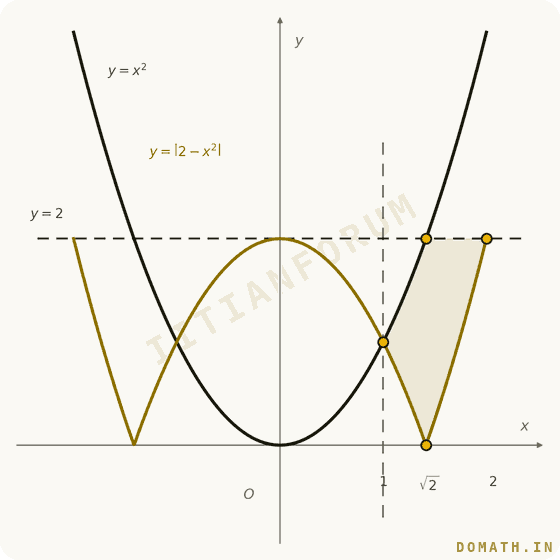
Find the area of the region bounded by the curves y=x2y = x^2, y=∣2−x2∣y = \left|2-x^2\right| and y=2y = 2, which lies to the right of the line x=1x = 1.
Solution
Answer: 1.01 (± 0.01)
Question attachment Step 1:
∣2−x2∣={2−x2,∣x∣≤2,x2−2,∣x∣>2.\left|2-x^2\right| = \begin{cases} 2-x^2 , & \left|x\right|\le\sqrt2 ,\\ x^2-2 , & \left|x\right|>\sqrt2 .\end{cases}
So the description of the region changes at x=2x = \sqrt2. At x=1x = 1 the two curves meet, x2=1=∣2−x2∣x^2 = 1 = \left|2-x^2\right|, so the region closes on the left. Step 2: For x>1x>1,
y=x2 meets y=2 at x=2;y=x2−2 meets y=2 at x=2y = x^2 \ \text{meets}\ y = 2 \ \text{at}\ x = \sqrt2 ;\qquad y = x^2-2 \ \text{meets}\ y = 2 \ \text{at}\ x = 2
So the region runs from x=1x = 1 to x=2x = 2. Step 3: Case-I: 1≤x≤21\le x\le\sqrt2. Here y=x2y = x^2 rises from 11 to 22 and ∣2−x2∣=2−x2\left|2-x^2\right| = 2-x^2 falls from 11 to 00, and x2≥2−x2x^2 \ge 2-x^2 for x≥1x\ge1. The line y=2y = 2 is above both. So the strip is bounded above by x2x^2 and below by 2−x22-x^2:
A1=∫12[x2−(2−x2)]dx=∫12(2x2−2)dxA_1 = \int_1^{\sqrt2}\left[x^2-\left(2-x^2\right)\right]dx = \int_1^{\sqrt2}\left(2x^2-2\right)dx
Step 4: Case-II: 2≤x≤2\sqrt2\le x\le2. Now x2≥2x^2 \ge 2, so the parabola y=x2y = x^2 has left the strip and y=2y = 2 is the ceiling, while ∣2−x2∣=x2−2\left|2-x^2\right| = x^2-2 is the floor, x2−2≤2x^2-2 \le 2 holding for x≤2x\le2:
A2=∫22[2−(x2−2)]dx=∫22(4−x2)dxA_2 = \int_{\sqrt2}^{2}\left[2-\left(x^2-2\right)\right]dx = \int_{\sqrt2}^{2}\left(4-x^2\right)dx
Step 5:
A1=[2x33−2x]12=(423−22)−(23−2)=−223+43=4−223A_1 = \left[\frac{2x^3}{3}-2x\right]_1^{\sqrt2} = \left(\frac{4\sqrt2}{3}-2\sqrt2\right)-\left(\frac23-2\right) = -\frac{2\sqrt2}{3}+\frac43 = \frac{4-2\sqrt2}{3}
A2=[4x−x33]22=(8−83)−(42−223)=163−1023=16−1023A_2 = \left[4x-\frac{x^3}{3}\right]_{\sqrt2}^{2} = \left(8-\frac83\right)-\left(4\sqrt2-\frac{2\sqrt2}{3}\right) = \frac{16}{3}-\frac{10\sqrt2}{3} = \frac{16-10\sqrt2}{3}
Step 6: On adding,
A=4−22+16−1023=20−1223=203−42A = \frac{4-2\sqrt2+16-10\sqrt2}{3} = \frac{20-12\sqrt2}{3} = \frac{20}{3}-4\sqrt2
≈6.66667−5.65685=1.00981  ⟶  1.01\approx 6.66667-5.65685 = 1.00981 \;\longrightarrow\; 1.01
Answer: 1.011.01 (exactly 203−42\dfrac{20}{3}-4\sqrt2)
Still stuck on this question?Ask your doubt on WhatsApp
Similar questions
Application of Integrals · medium
In the coordinate plane, the region MM consists of all the points (x,y)\left(x,y\right) satisfying the inequalities y≥0y \ge 0, y≤xy \le x and y≤2−xy \le 2-x simultaneously. The region NN, which varies with the parameter tt, consists of all the points (x,y)\left(x,y\right) satisfying the inequalities t≤x≤t+1t \le x \le t+1 and 0≤t≤10 \le t \le 1 simultaneously. The area of M∩NM \cap N is −k1t2+k2t+12-k_1t^2+k_2t+\dfrac12, then k1+k2k_1+k_2 is
Application of Integrals · medium
Let PP be a point (not the origin) lying on the parabola x2=yx^2 = y. The normal line to the parabola at PP will intersect the parabola at another point QQ. The minimum possible value for the area bounded by the line PQPQ and the parabola is
Application of Integrals · medium
The area of the region {(x,y):0≤y≤6−x, y2≥4x−3, x≥0}\{(x,y):0\le y\le6-x,\ y^2\ge4x-3,\ x\ge0\} is
Application of Integrals · hard
Let ee be the base of natural logarithm and let f:{1,2,3,4}→{1,e,e2,e3}f:\{1,2,3,4\}\to\{1,e,e^2,e^3\} and g:{1,e,e2,e3}→{1,12,13,14}g:\{1,e,e^2,e^3\}\to\left\{1,\dfrac12,\dfrac13,\dfrac14\right\} be two bijective functions such that ff is strictly decreasing and gg is strictly increasing. If ϕ(x)=[f−1{g−1(12)}]x\phi(x)=\left[f^{-1}\left\{g^{-1}\left(\dfrac12\right)\right\}\right]^x, then the area of the region R={(x,y):x2≤y≤ϕ(x), 0≤x≤1}R=\{(x,y):x^2\le y\le\phi(x),\ 0\le x\le1\} is

Solve more, learn faster

Sign up free to solve more JEE Maths questions and explore doMath — timed drills, mastery sprints, bookmarks, and chapter-wise progress tracking.