Complex Numbers: Let Complex Numbers Satisfying Non Real Cube Root
JEE Maths reading comprehension with full step-by-step solutions.
Passage
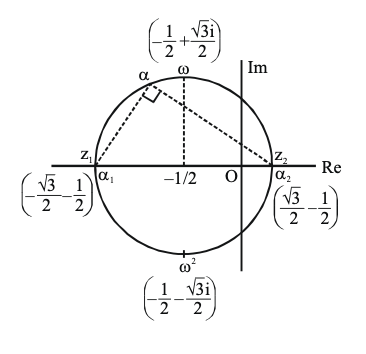
Let z1 and z2 be two complex numbers satisfying
(z−ω)2+(z−ω2)2=0,
where ω is a non-real cube root of unity. Also let α be a variable point on the circle
z+21=23,
and let α1, α2 be the values of α for which ∣α∣ is maximum and minimum respectively.
Question 1 · Single correct
The value of expression
∣z1−α∣2+∣z2−α∣2+∣ω−α∣2+ω2−α2
is
A3
B3
C6correct
D1
Solution
Step 1: Solve the quadratic for z. Expanding,
2z2−2z(ω+ω2)+ω2+ω4=0.
Step 2: Simplify using 1+ω+ω2=0 and ω3=1:
ω+ω2=−1,ω4=ω,ω2+ω4=ω2+ω=−1.
So the equation becomes
2z2+2z−1=0.
Step 3: Solve it.
z=4−2±4+8=2−1±3,
so
z1=2−1−3,z2=2−1+3,
both real.
Step 4: Show these are ends of a diameter of the given circle. The circle has centre −21 and
radius 23, and
z1=−21−23,z2=−21+23,
i.e. the centre displaced by ∓ the radius along the real axis. So z1z2 is a diameter.
Step 5: Show ω and ω2 are also ends of a diameter of the same circle. With
ω=−21+23i and ω2=−21−23i,
ω+21=23i=23✓,
and likewise for ω2; they are the centre displaced by ± the radius along the imaginary
axis.
Step 6: Use the semicircle right-angle property. If A and B are ends of a diameter and α
is any other point of the circle, then ∠AαB=90∘, so by Pythagoras
∣A−α∣2+∣B−α∣2=∣AB∣2=(2r)2.
Step 7: Apply it to each diameter, with 2r=3:
∣z1−α∣2+∣z2−α∣2=3,∣ω−α∣2+ω2−α2=3.
Step 8: Add.
3+3=6.
(Notice the answer does not depend on where α sits on the circle.)
Answer: (3).
Question 2 · Single correct
Which of the following is incorrect?
A∣α1∣+∣α2∣=∣α1−α2∣
Bα1=z2 and α2=z1, where z1<0, z2>0correct
C∣2z1+1∣=∣2z2+1∣
Damp(z2z1)=amp(z1z2)
Solution
Step 1: Get z1 and z2 (as in the previous question). The equation reduces to
2z2+2z−1=0, so
z1=2−1−3≈−1.366,z2=2−1+3≈0.366,
matching the stated signs z1<0 and z2>0.
Step 2: Find α1 and α2. On a circle, the points nearest to and farthest from an
external point lie on the line through that point and the centre. Here the origin and the centre
−21 both lie on the real axis, so α1,α2 are the two points where the circle
meets the real axis:
−21±23,i.e. exactly z1 and z2.
Step 3: Decide which is which.
∣z1∣=21+3≈1.366,∣z2∣=23−1≈0.366.
So the maximum occurs at z1 and the minimum at z2:
α1=z1,α2=z2.
Step 4: Test (B). It claims α1=z2 and α2=z1 - the two are swapped. So (B) is
incorrect, and that is what the question asks for. Confirm the other three are correct.
Step 5: Test (A). Since z1<0<z2, the origin lies between them, so
∣α1−α2∣=∣z1−z2∣=3=21+3+23−1=∣α1∣+∣α2∣.
Step 6: Test (C).
∣2z1+1∣=−1−3+1=3,∣2z2+1∣=−1+3+1=3.
(Equivalently, both say the distance from the centre is one radius.)
Step 7: Test (D). As z1<0 and z2>0, both z2z1 and z1z2 are negative reals,
so both amplitudes equal π.
Answer: (2).
Question 3 · Single correct
The number of complex numbers α such that
∣α−α1∣+∣α−α2∣=6
is
A4
B3
C2correct
D0
Solution
Step 1: Recall from the paragraph that
α1=−21−23,α2=−21+23,
so the distance between them is ∣α1−α2∣=3.
Step 2: Recognise the condition. "Sum of distances from two fixed points is constant" is the
definition of an ellipse with α1,α2 as foci, provided the constant exceeds the
distance between the foci. Here 6>3 ✓, so it is a genuine ellipse.
Step 3: Extract its dimensions. With 2a=6 and 2c=3,
a=26,c=23,b2=a2−c2=46−43=43⟹b=23.
Step 4: Compare with the circle. The ellipse is centred at −21 - the same centre as the
circle - and its semi-minor axis b=23 is exactly the circle's radius.
Step 5: So the circle is the "minor-axis circle" of the ellipse: it lies inside the ellipse and
touches it only at the two ends of the minor axis. Since α is restricted to the circle, we
want how many points lie on both curves.
Step 6: Verify algebraically. Writing X=x+21, the circle is X2+y2=43 and
the ellipse is 3/2X2+3/4y2=1. Substituting
X2=43−y2 into the ellipse:
 Step 1: Solve the quadratic for . Expanding,