Mastering Mathematics: The Method, Not the Hours
Every year a few students tell me the same thing in the first week: "Sir, I understand everything in class, but I cannot solve." They are not lying, and they are not weak. They have simply been studying mathematics the way they study every other subject, and mathematics does not answer to that method.
This post is about the method. Not about which book, not about how many hours. About what you actually do in those hours.
Mathematics is a skill, not a syllabus
You can read a chapter of chemistry, close the book, and genuinely know more than you did an hour ago. Try that with mathematics and you will find you know nothing at all the moment a question is in front of you.
The reason is that mathematics is a collection of skills, and a skill only exists in the doing. Understanding a concept is the first half of the work. The second half is applying it across enough problems that your hand knows what to do before your head has finished reading the question. Students who skip the second half are the ones who say "I understood it in class."
So the rule is simple and it is not negotiable: a concept is not finished until you have solved with it.
Reading a solution and thinking "yes, I would have done that." You would not have. Reading a solution is not practice, it is watching someone else practise. Close the book, take a blank sheet, and produce it yourself. The gap between those two experiences is where your marks are hiding.
You cannot learn mathematics by halves
Mathematics is the one subject where the chapters are wired to each other. Quadratic equations sit inside coordinate geometry. Trigonometry sits inside integration. Functions sit inside almost everything. Skip one link and the chain does not break loudly, it breaks quietly, three chapters later, in a question you cannot see the entry point to.
This is why the order matters. In every other subject you can start where you like. Here, if you have not settled functions and graphs, application of derivatives will feel unreasonably hard, and you will blame the chapter instead of the gap.
If a chapter feels impossibly difficult, the honest first question is not "how do I get better at this chapter." It is "what earlier chapter am I missing."
Which earlier chapter to repair when a chapter feels impossible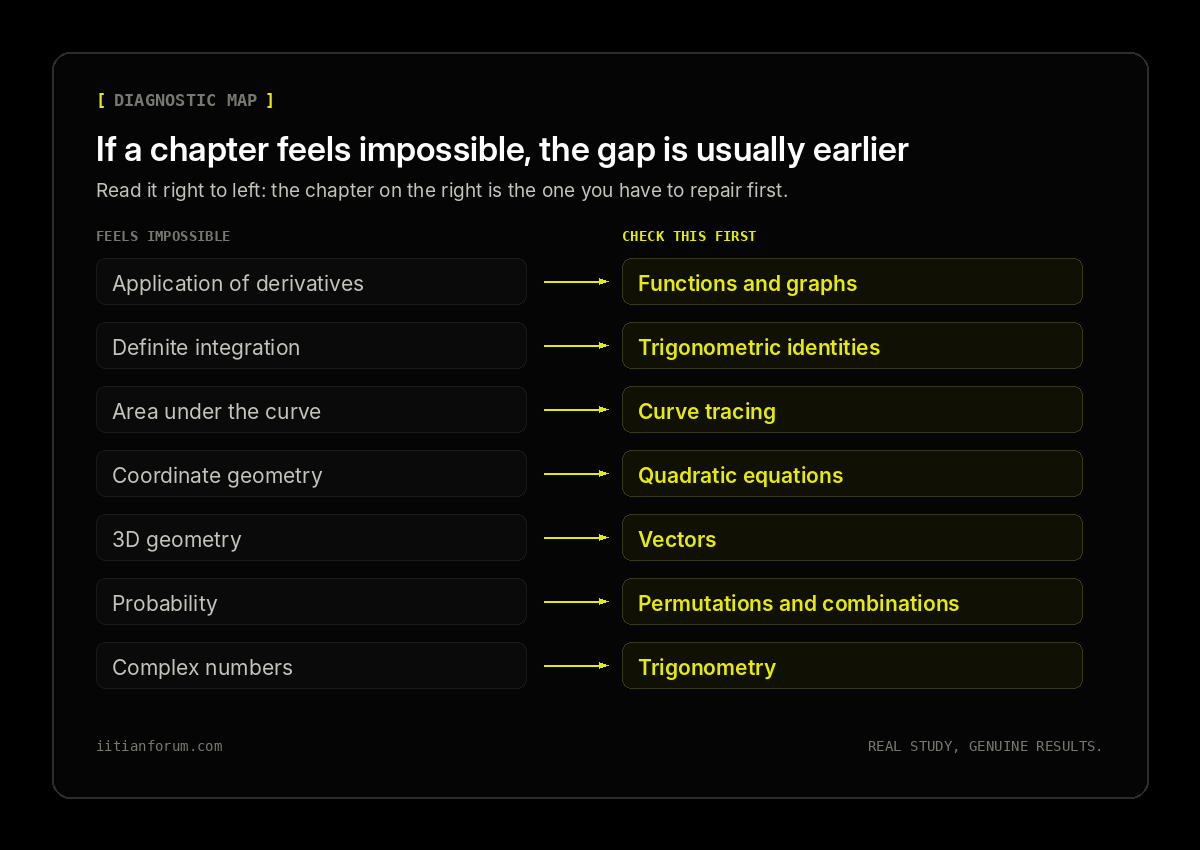
The questions are more predictable than you think
Here is something that surprises students. Compared with almost any other subject, JEE mathematics is repetitive. Not the numbers, the shapes. Sit with ten years of papers and you will start seeing the same dozen or so moves again and again, wearing different clothes.
A region bounded by two curves. A functional equation that closes after four compositions. A circle cut by a chord. A modulus that has to be resolved before anything else can happen. Once you have met a move six or seven times, you stop solving the question and start recognising it, and recognition takes seconds where solving takes minutes.
That is the whole payoff of past papers. Not the answers. The pattern library.
How to build the library
Keep one notebook that is not a solution notebook. In it, for every question that gave you trouble, write two lines only: what the question looked like, and what the move was. "Area between a parabola and a line, both natural in , so integrate in and skip the square root." Six months of that notebook is worth more than six months of solved sums, because you can revise it in an hour.
Homework and self study are two different jobs
Assigned work and your own work do different things, and doing one does not excuse the other.
Assigned work is calibration. Somebody who knows the exam has chosen those questions in that order for a reason, and finishing them tells you whether today's class actually landed. Your own work is repair. It is where you go back to the thing you got wrong last week, at your own pace, with nobody watching.
Students who only do assigned work stay exactly as good as the assignments. Students who only do their own work drift, because nobody is checking their calibration. You need both, and they need separate slots in the day.
Practice is the only thing that moves the needle
Every strong student I have taught has one thing in common, and it is not talent. It is that they touch mathematics every single day. Not four hours on Sunday. Forty minutes on Monday, Tuesday, Wednesday.
The subject rewards frequency over volume because what you are building is fluency, and fluency decays. A week away from integration and you will feel it, in a way you would not feel a week away from organic chemistry.
Start easy when you start a topic. Not because easy questions are worth marks, but because they are how you build familiarity fast enough to attempt the hard ones with something in hand. Beginning a new chapter with its hardest exercise is a good way to convince yourself you are bad at it.
Attack the weak spot, do not walk around it
There is a very human instinct in preparation: do the chapter you are already good at, because it feels good. Everyone does it. It is also the single biggest waste of study time in the whole year.
Being aggressive in mathematics does not mean solving more. It means going straight at the topic you have been avoiding, and staying there until it stops being the one you avoid. Three concrete habits that make this possible:
- Cut the hints. No looking at the solution for at least fifteen minutes, and no calculator for arithmetic you should be able to do. Both feel efficient and both stop you learning.
- Do not give up on the first wrong turn. A wrong approach that you carry to the end and then diagnose teaches you more than a correct approach you were handed.
- Start again without shame. If four lines in you are not sure the method is right, scrap it and restart. Restarting costs two minutes. Committing to a bad method costs the question.
Test yourself before the exam does
Solving chapter-wise is comfortable, because you already know which chapter the question came from. The exam does not offer that. That single difference is why students who are strong in practice sometimes underperform in mocks.
Revision exercises, assignments and full past papers do two things at once. They tell you where you are actually weak, which is rarely where you think you are. And they build exam temperament, which is a real and trainable skill: pacing, deciding fast whether a question is worth your next six minutes, and staying calm after one goes wrong.
Take mocks under real timing. A mock taken with pauses is not a mock, it is a worksheet.
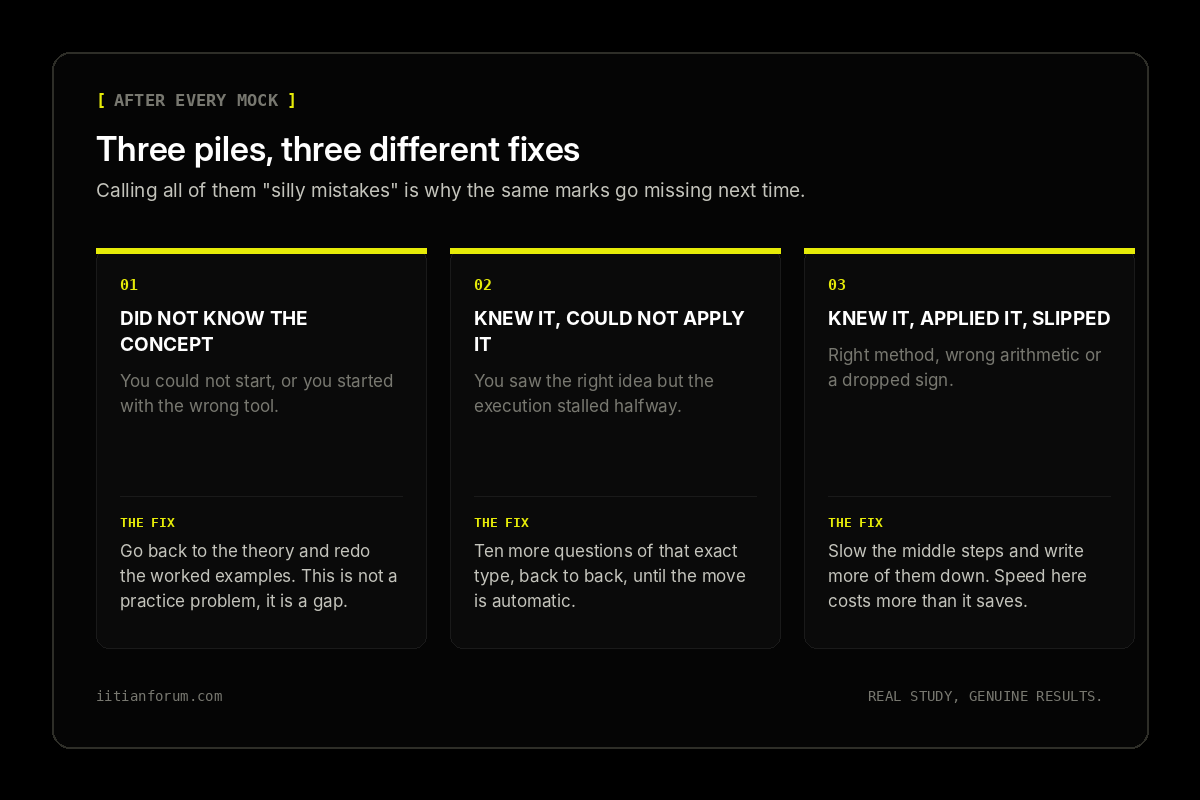
Sort your wrong answers into three piles. Did not know the concept. Knew it but could not apply it. Knew it, applied it, made an arithmetic slip. Those three need three completely different fixes, and lumping them together as "silly mistakes" guarantees you fix none of them.
Plan by weightage, not by enthusiasm
I have watched a student spend three weeks on indefinite integration, going far past anything the exam would ever ask, while leaving 3D geometry untouched. He worked genuinely hard. He also lost marks doing it.
Be professional about this. You are not doing research on a topic, you are preparing for a paper with a known shape. Some segments carry two or three questions and no more, however deep they go. Others carry six. Your time should follow that, weighted by where you are currently weak.
The plan writes itself once you have the two numbers: how many marks a chapter carries, and how strong you are in it. Spend most time where the product of "carries marks" and "you are weak" is largest.
A grid of weightage against your own weakness, with the start-here quadrant marked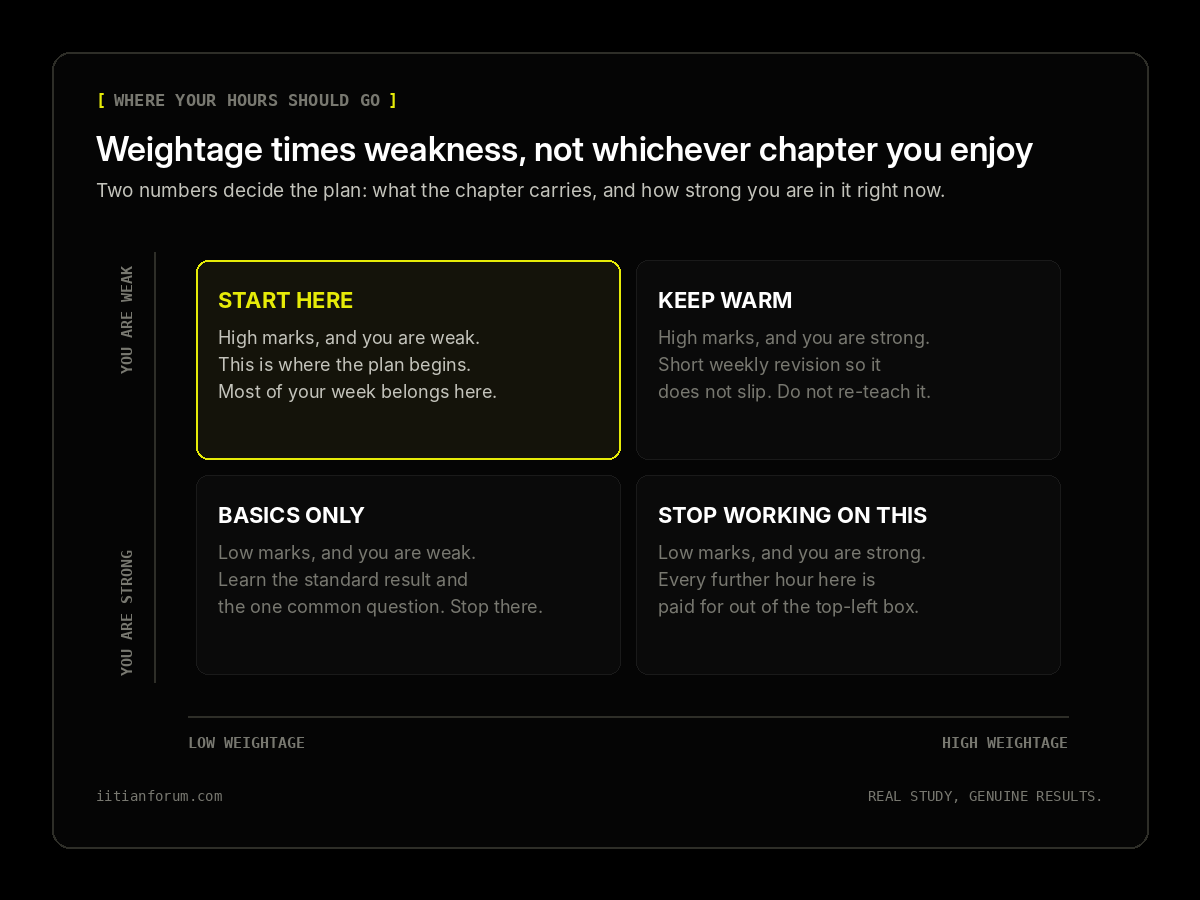
The whole thing, in one place
| Habit | What it fixes |
|---|---|
| Solve before you call a concept finished | Understanding without application |
| Learn in order, repair the earlier gap | The chapter that feels impossible |
| Keep a moves notebook from past papers | Slow recognition in the exam |
| Assigned work and self study, both, daily | Drift and false confidence |
| Touch the subject every day, not every Sunday | Fluency decay |
| Go at the weak topic, not around it | The comfortable waste of time |
| Full mocks under real timing | Exam temperament |
| Allocate time by weightage times weakness | Overdoing one part at the cost of another |
None of this is a shortcut, and I would not offer you one. Mathematics gives its marks to the student who sat with it daily and went at the parts that hurt. That is the entire secret, and it is available to everybody.
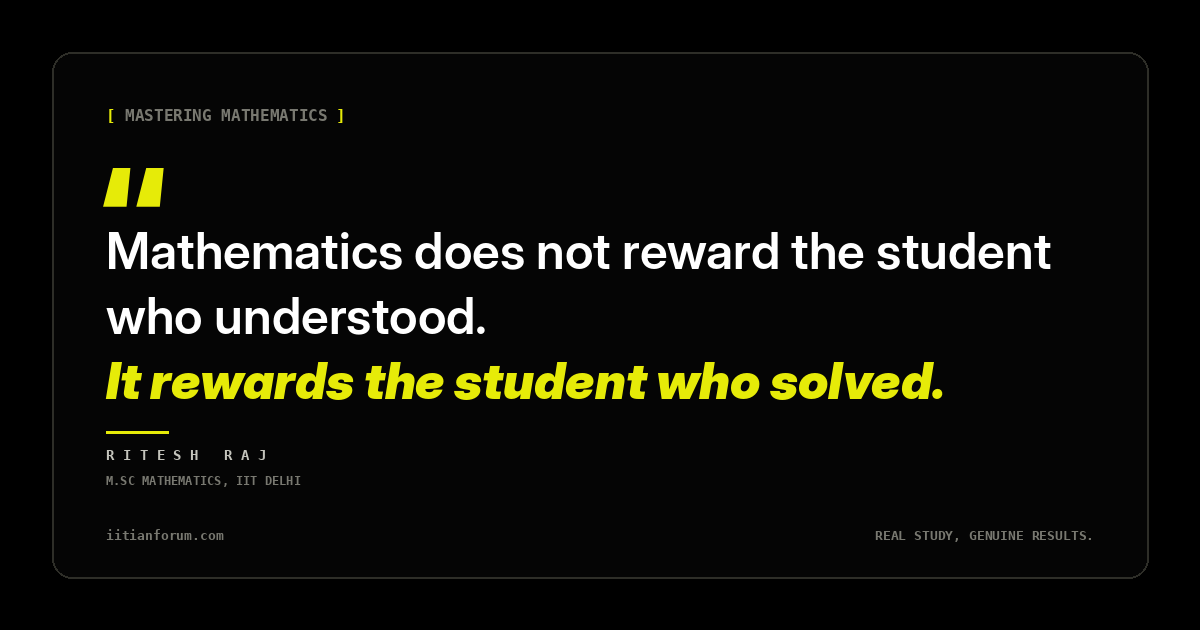
Ritesh Raj
Founder and Lead Mentor at IITian Forum. M.Sc Mathematics, IIT Delhi. 500+ students mentored for JEE and Olympiad mathematics.